Why this problem matters
Private schools are expected to communicate quickly and clearly with families across multiple channels. In practice, admissions and student-support teams are often lean, which creates response backlogs during peak periods.
The pressure gets higher when schools serve families who prefer different languages. If translation and routing are handled manually, teams usually face three predictable issues:
- response delays on routine inquiries
- inconsistent messaging quality across channels
- overloaded staff who spend too much time on repetitive drafting
A better operating model is to treat AI as a workflow layer that assists drafting, translation, and triage while keeping human approval in control.
What the workflow looks like
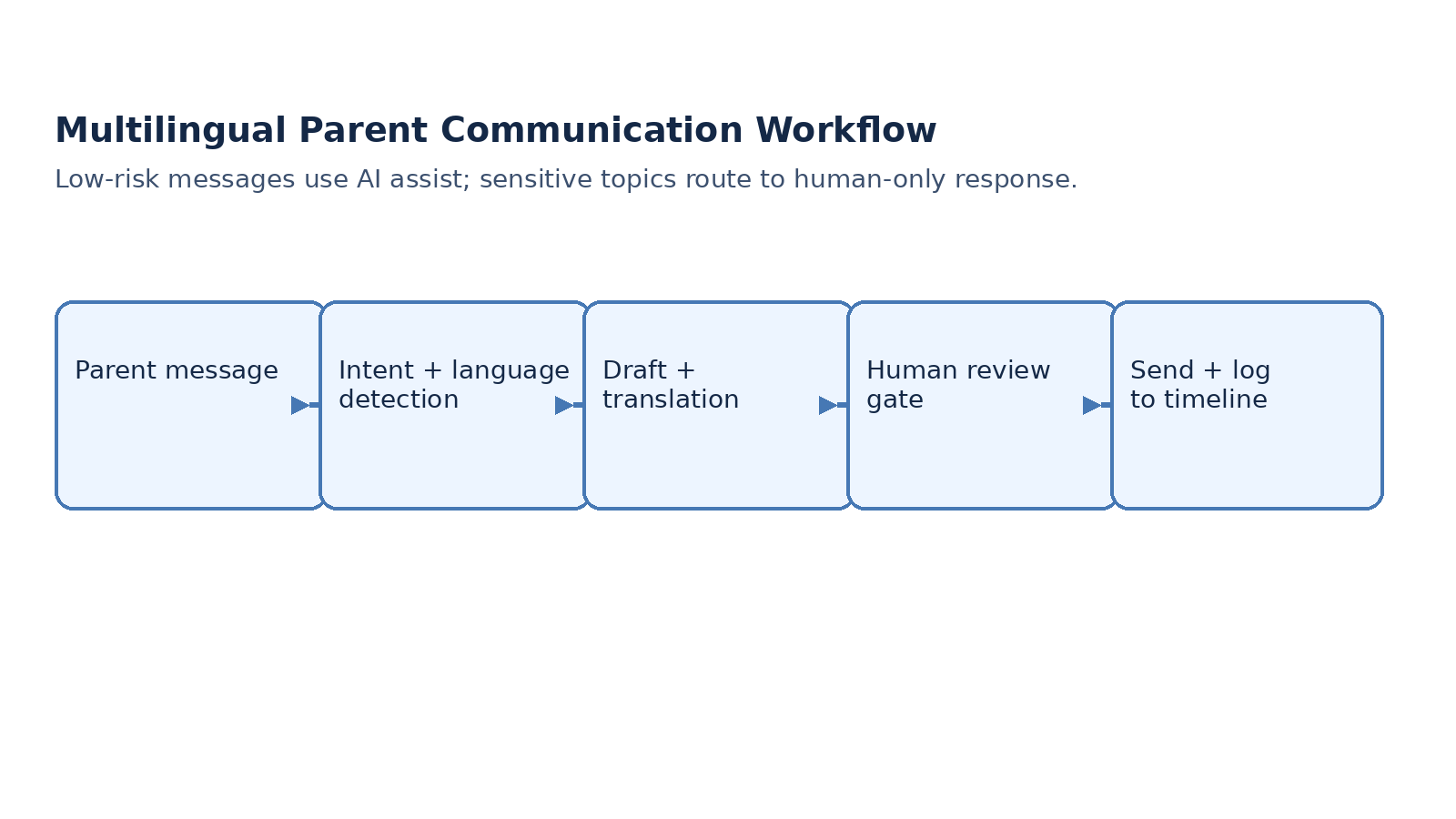
A practical SLA-focused communication workflow can be implemented in five steps:
- Parent message enters a unified inbox.
- AI classifies intent and detects language.
- AI drafts a suggested response and translated variant.
- Staff approves, edits, or escalates based on policy.
- Final message is sent and logged to the contact timeline.
This structure improves speed without making communication fully autonomous.
Define AI-allowed vs human-only categories early
Before rollout, create a routing matrix with clear ownership:
| Message category | Handling model | Owner |
|---|---|---|
| Event logistics, schedule clarifications, routine reminders | AI-assisted draft + human approval | Front office / grade coordinator |
| Attendance follow-up and non-sensitive administrative requests | AI-assisted draft + human approval | Student support |
| Financial aid, disciplinary issues, health/safety concerns, legal complaints | Human-only response (AI may summarize internally) | Designated office lead |
This single policy table prevents most workflow confusion.
Tools that fit this use case
The strongest stack combines school-system context with controlled communication channels:
- School communication platform for unified inboxes, translation support, and conversation records.
- SIS integration for guardian language preferences and contact accuracy.
- Policy-safe AI layer for drafting, summarization, and translation assistance.
- Operational dashboarding for response-time and SLA tracking by language segment.
The key is not tool novelty. It is role clarity, auditability, and queue ownership.
What a realistic 60-day rollout looks like
A low-risk pilot can be run in one division and one office first.
Weeks 1-2: Baseline and governance
- map top message categories
- define escalation triggers
- clean guardian language-preference fields in SIS
- set baseline metrics for response time and SLA attainment
Weeks 3-6: Low-risk deployment
- enable AI-assisted drafting for routine categories
- require staff approval on every outbound message
- review daily queues for exception handling
Weeks 7-8: Escalation tuning and QA
- add high-risk keyword and intent routing
- sample translated outputs for quality assurance
- refine category definitions from real message data
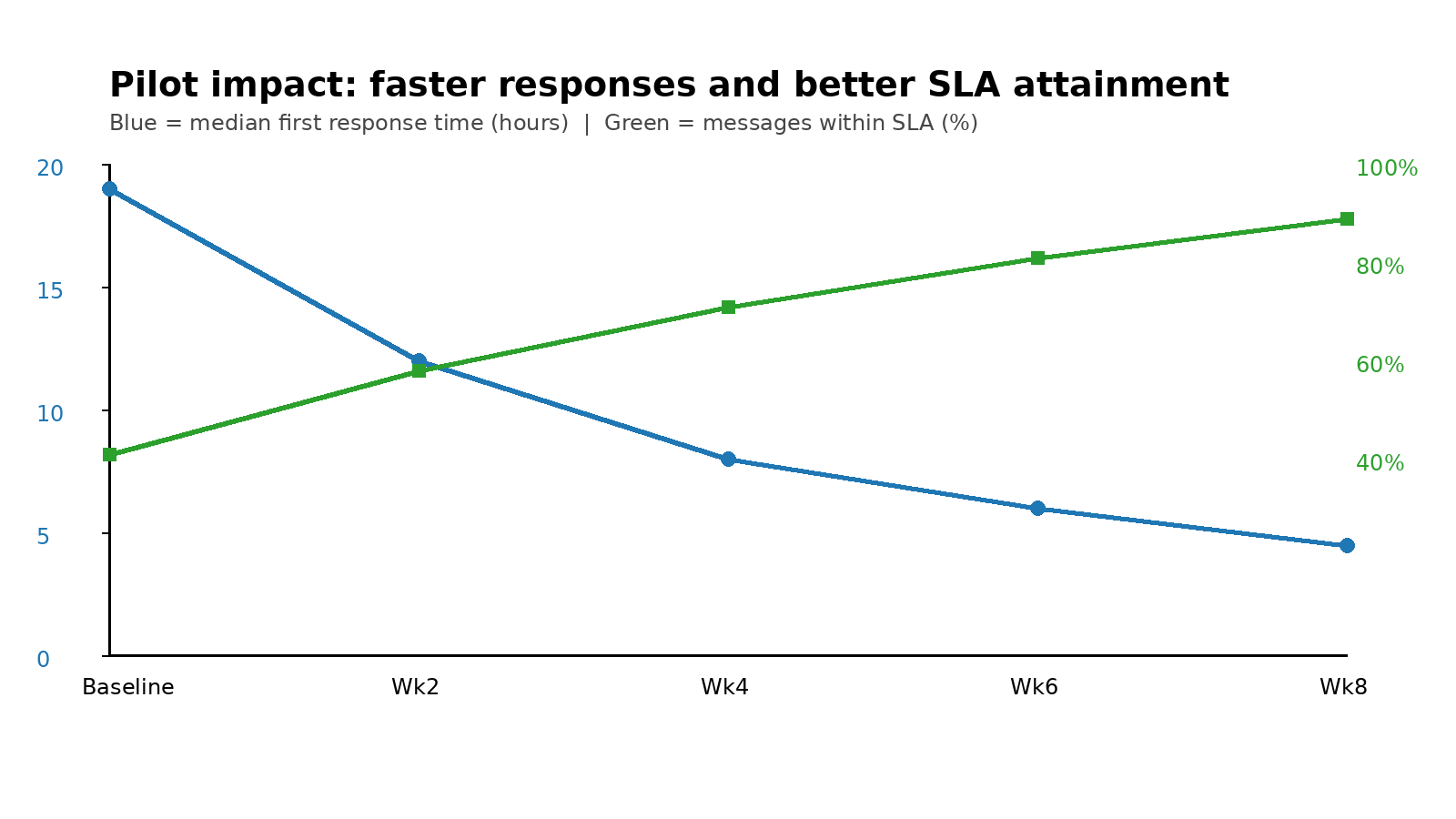
Track weekly pilot outcomes and compare against baseline.
Success metrics to report to leadership
Focus on a short, operational metric set:
- median first-response time by category and language
- percentage of messages answered within SLA
- translation turnaround time
- escalation routing accuracy
- staff time saved per 100 inbound messages
These metrics show whether the workflow actually improves parent experience and staff capacity.
Final takeaway
Private schools do not need autonomous messaging bots to improve communication performance. They need a controlled AI-assisted workflow with clear risk boundaries, defined queue ownership, and measurable SLA targets.
Start narrow, keep humans in approval loops, and treat multilingual communication as a core operations system rather than a side task.